On this page · 7 sections
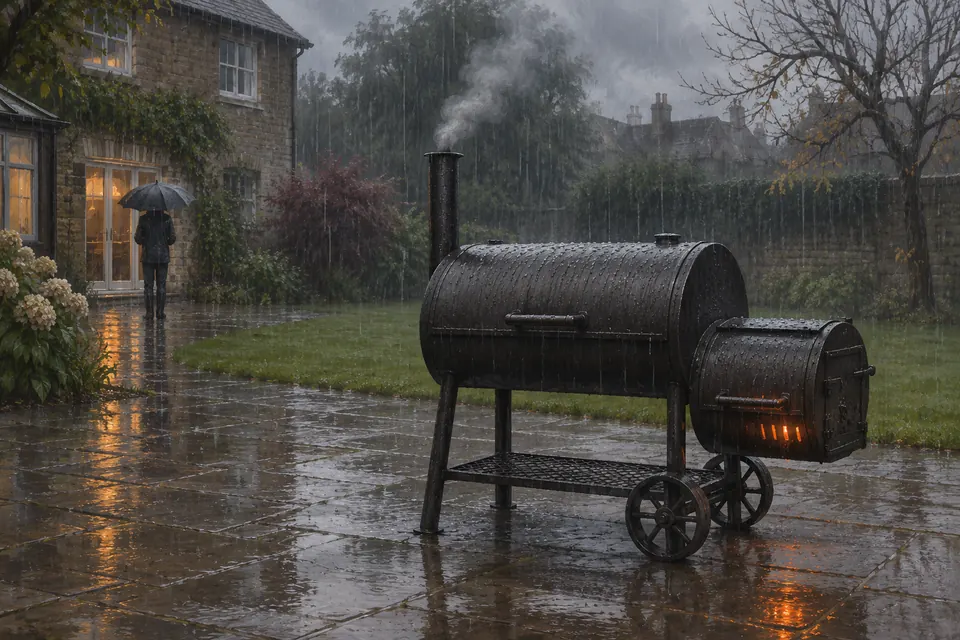
Rain is the least of your problems. Every British smoker owner learns this eventually, usually around hour five of a pork shoulder, standing under a brolly watching drops hiss off the lid while the temperature holds perfectly steady. What actually ruins wet-weather cooks is the wind that comes with the rain, damp fuel, and the temptation to drag the smoker somewhere it absolutely shouldn't go.
If you've planned a Saturday around a brisket and opened the curtains to a sky the colour of a wet slate roof, carry on. Just change a few things.
What rain and wind actually do
Rain cools the outside of the smoker. Water lands on hot metal or ceramic, evaporates and takes heat with it. The fire burns a little harder to keep the inside at the same temperature, so you use more fuel and the smoker takes longer to recover after the lid's been opened. The food doesn't know it's raining.
Wind is the real enemy. It does two things at once. It blows across the outside of the smoker and carries heat away much faster than still air. And it forces extra air into the intake, so the fire flares and burns hot, then fades when the gust drops. The result is a temperature that wanders up and down and a fuel pile that disappears faster than you'd expect. A grey, drizzly, still day is far kinder than a dry, blustery one.
Cold makes both worse. The colder the air, the more heat the smoker has to replace. A rainy October afternoon will use noticeably more fuel than a rainy June one.
All three add time to the cook, so plan for the slow end of every time range.
How each smoker copes
Not every smoker minds the weather equally. Thick walls and insulation help; thin steel suffers.
| Smoker | Rain | Wind | What to watch |
|---|---|---|---|
| Ceramic kamado | Copes very well; thick walls hold heat | Copes well | Keep the bottom vent out of the rain; ceramic can crack if cold water hits it when very hot, so check the maker's advice |
| Insulated cabinet or gravity-fed | Copes well | Copes well | Keep the hopper or fuel door closed and dry |
| Bullet smoker | Fair | Struggles; thin walls and a big surface | Shelter from wind, extra fuel |
| Kettle BBQ | Fair | Struggles | Snake method, shelter, extra briquettes |
| Offset smoker | Fair on thick steel, poor on thin | Struggles, especially at the firebox | Feed little and often; keep splits dry |
| Pellet grill | Copes if the hopper stays dry | Fair | Wet pellets are the main risk; electrics need protecting |
| Electric smoker | Depends entirely on the maker's rating | Fair | Follow the manual on outdoor and wet use |
If you're choosing a smoker and you plan to cook year-round in Britain, weather resistance deserves a place on your list. Our guide on which smoker to buy factors it in.
Safe shelter
This part matters for safety as well as for the food.
Never take a charcoal or wood smoker into an enclosed or partly enclosed space. That means no garages (door open or not), no sheds, no tents, no gazebos with the sides down, no conservatories and no porches. Smouldering charcoal and wood produce carbon monoxide, which you can't see or smell, and it builds up quickly in a space with limited airflow. Fire and rescue services in the UK warn about this every summer, and it applies just as much when it's raining.
What you can do safely:
- Open-sided cover, well above and clear of the smoker. A gazebo or canopy with all sides open, high enough that heat and smoke escape freely and nothing hangs near the lid or chimney. Many gazebo fabrics will scorch or melt, so keep plenty of distance and follow the maker's guidance on use near heat. Smoke should never be pooling under the roof.
- A windbreak, not a wall. A hedge, garden wall, fence or freestanding screen upwind of the smoker, with a good gap between them. You want the gust stopped before it reaches the smoker, not the smoker tucked into a corner.
- Clearance from buildings. Keep the smoker away from house walls, fences, sheds, overhanging trees and eaves. Check the smoker manual and your local fire and rescue service's barbecue safety advice for clearance distances.
- A stable, level, non-combustible base. Wet decking gets slippery, and a smoker on a wobbly paving slab is a bad mix with a wet lawn.
A large garden umbrella for the cook is well worth having. You're the one who needs to stay dry.
Keep spare charcoal, briquettes and wood in a sealed plastic tub by the back door. Damp fuel is the most common reason a rainy cook goes wrong: it smoulders, smokes white and refuses to hold temperature.
Pellet and electric smokers in the wet
Pellets hate water. Wet pellets swell, crumble back into sawdust and can jam the auger that feeds the fire, which can mean a stalled cook and a fiddly clean-out. Keep the hopper lid shut, top it up from a dry bag under cover, and store spare pellets indoors or in a sealed container. If water gets into the hopper, stop and empty it rather than hoping for the best. More in our guide to wood pellets in the UK.
Electrics and rain need care. Pellet grills and electric smokers both run on mains power. Follow the maker's manual on outdoor use in wet weather, which varies by model. As general practice, use an outdoor-rated socket with RCD protection, keep plugs and extension connections off the ground and out of puddles, and don't run leads across wet grass where they'll be trodden on. If the manual says not to use it in the rain, believe it. Our electric smokers guide covers what to look for.
Covers and insulation blankets
Storage covers are for storage. Never cook with a storage cover on, or draped over part of the smoker. It's a fire risk and it'll melt. Let the smoker cool completely before covering it after a wet cook, and leave the vents slightly open so trapped moisture can escape. Cover up while it's still warm and you'll find a fine layer of mould inside next time.
Thermal jackets or insulation blankets are made for some smokers, mainly bullets, kettles and pellet grills, to cut heat loss in cold and wind. They can make a real difference to fuel use and stability in bad weather. Use only one designed for your smoker, and check the maker's guidance on whether it can be used during a cook and where it must stay clear of vents and hot spots. Improvised blankets are a bad idea: a camping mat or moving blanket over a hot smoker is a fire waiting to happen.
A wet-weather cook plan
- Check the forecast for wind, not just rain. A still, drizzly day is fine. Gusts are the problem.
- Pick your spot the night before, sheltered from the prevailing wind with open sky above, clear of the house and fence.
- Plan extra fuel. Use the smoker fuel calculator and add a generous margin on top for a wet, windy day.
- Add an hour to the timings in the smoking time planner. Weather pushes cooks long, so plan to finish early and hold.
- Set up shelter for the cook. Brolly, waterproof, wellies, a dry place to put the tongs.
- Open the lid as little as possible. Every opening lets the cold in and costs recovery time. A wireless probe is worth its weight on a wet day.
- Have a fallback. If the weather turns properly nasty, wrap the meat once the bark has set and finish it in a low oven. Nobody needs to know.
Our guide to smoker temperature control covers holding steady in gusty conditions, and smoking in winter deals with frost and the short days.
Before the next wet weekend, buy a sealed tub for your fuel, find the most sheltered open-air corner of the garden and stand a windbreak in it.
FAQs
Can I use my smoker in the rain?
Yes. Rain mostly costs you fuel and time. Keep the fuel dry, shelter the smoker from wind and protect any electrics as the manual says.
Can I put my smoker in the garage when it rains?
No. A charcoal or wood smoker in a garage, even with the door open, can fill the space with carbon monoxide. Use open-sided cover outdoors instead.
Can I use a gazebo over my smoker?
Only with all sides open, enough height for heat and smoke to escape freely and plenty of clearance from the roof. Check the gazebo maker's guidance on use near heat; many fabrics melt or scorch.
Does rain affect the taste of smoked food?
Not directly. Damp fuel can make bitter, heavy smoke, and a fire struggling against the weather may smoulder badly. Keep fuel dry and the fire burning cleanly and the food tastes the same.
What if my pellets get wet?
Stop and empty the hopper. Wet pellets swell and break down and can block the auger. Clean it out following the manual before refilling with dry pellets.
Keep going
 Weather and kit
Smoking in winter
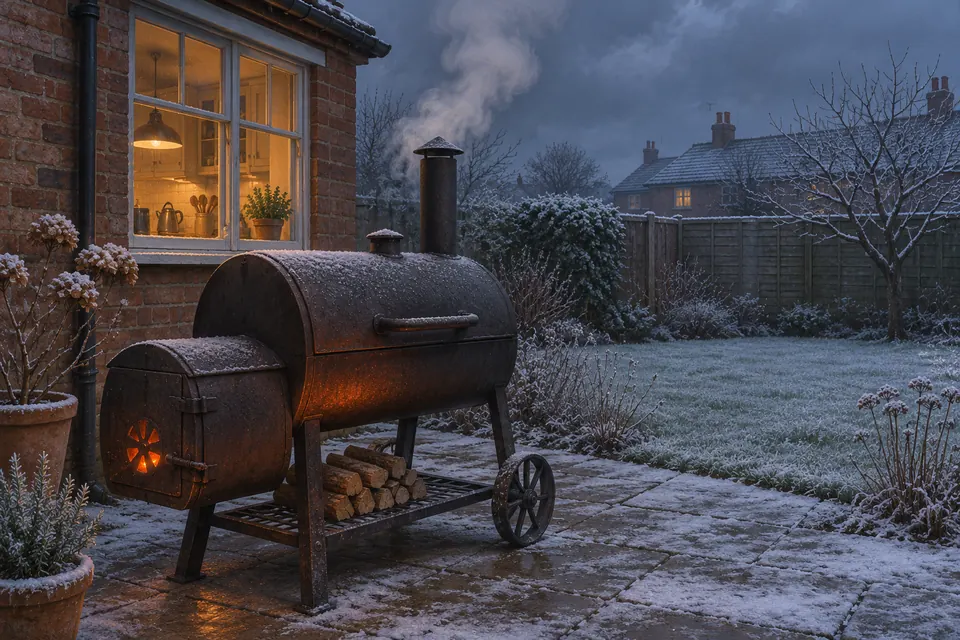
How to keep a smoker running through a British winter: cold and wind, extra fuel, insulation blankets, dark evenings, and why it never goes in the garage.
Read the guide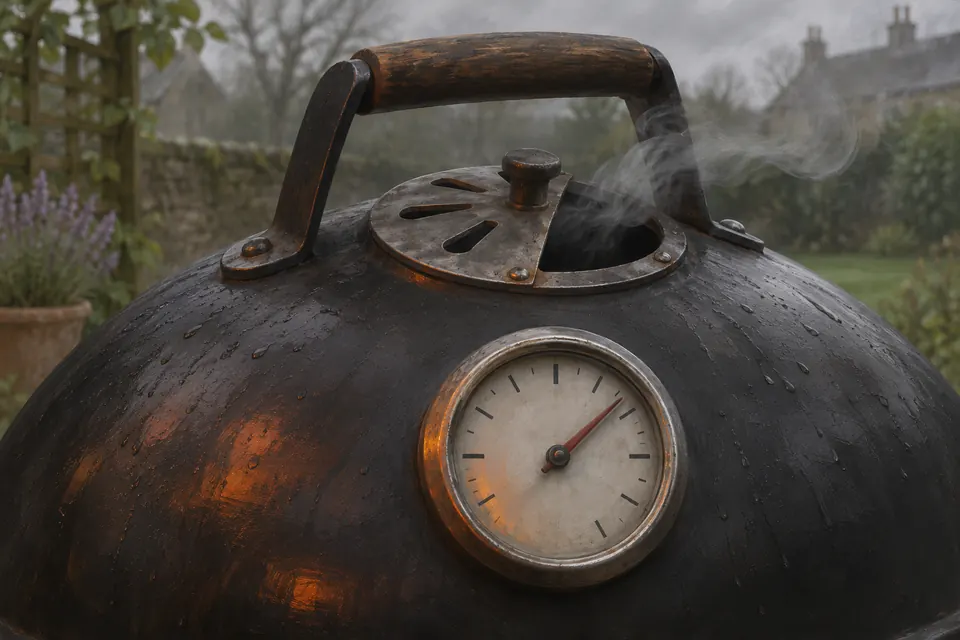 TechniqueCornerstone
Smoker temperature control
How to hold a steady smoker temperature with vents, fuel and placement, why the lid gauge lies, and what to do when the temperature drifts.
Read the guide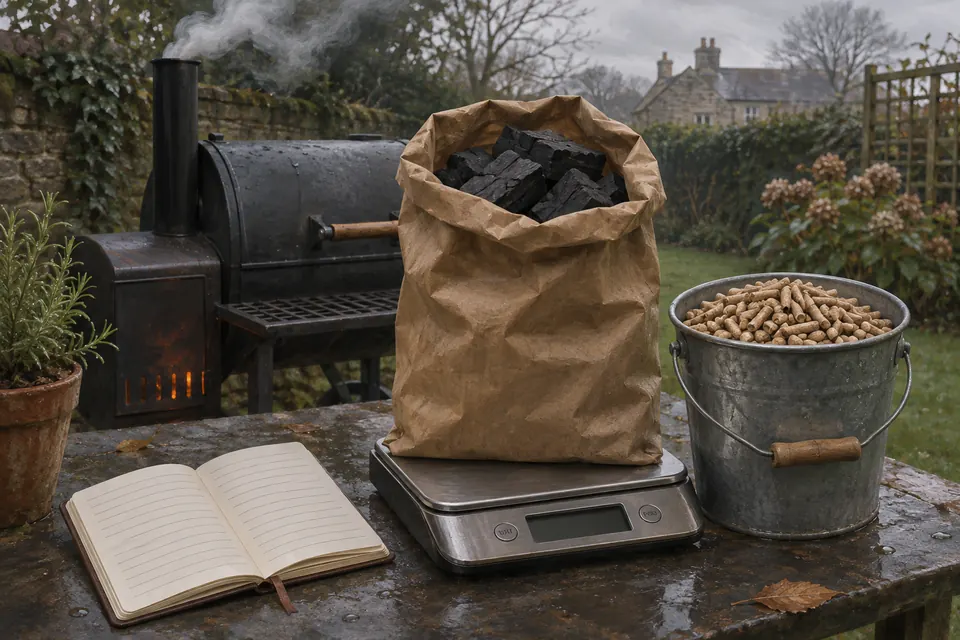 Tool
Smoker fuel calculator
Estimate how many kg of charcoal or pellets a cook will use, from cook length and burn rate.
Open the tool