On this page · 7 sections
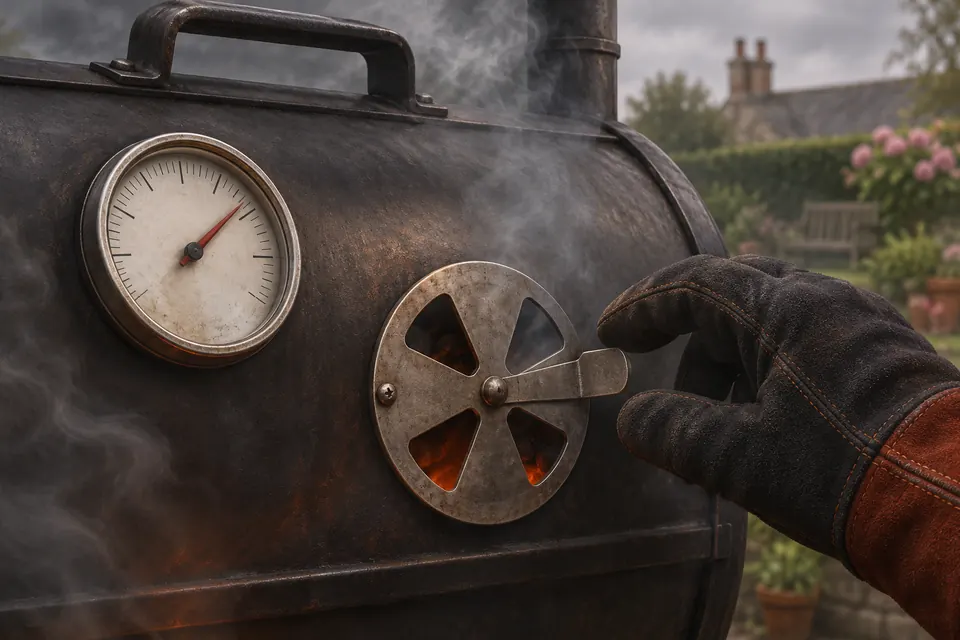
Find your symptom below, read the two or three sentences under it, fix it, and get the lid shut again. The answers are short on purpose: a smoker problem at 2pm with guests due at six is no time for theory. Each one links to the guide that explains the why, for a quieter evening.
Most problems trace back to three things: airflow, fuel and impatience. If you're not sure which section you're in, start with the fire.
Temperature problems
Why won't my smoker get hot?
Nine times out of ten it's airflow. Check that the bottom vent is open, the ash isn't piled up and smothering the coals, and the top vent is at least partly open, because a fire can't draw in air if nothing is leaving. If the vents are fine, you probably didn't light enough charcoal to begin with; our temperature control guide covers how much to start with.
Why does my smoker keep getting too hot?
Too much air, too much lit fuel, or both. Close the bottom vent most of the way and leave the top vent open, then wait a full 15 minutes before changing anything else. Next time, aim low and creep up, because a smoker that's overshot takes far longer to cool than one that's under. The snake method helps by lighting only a few coals at a time.
Why did the temperature spike when I opened the lid?
Lifting the lid floods the fire with oxygen, so it flares up as soon as you close it again. Keep lid openings short, and on a kamado "burp" it by lifting it an inch for a few seconds before opening fully. The spike usually settles on its own within 15 to 20 minutes, so resist the urge to shut every vent. Common smoking mistakes has more on lid-lifting habits.
Why does my lid thermometer disagree with my probe?
Because they're measuring different things. The lid gauge reads the air at the top of the dome, while a probe clipped at grate level reads where the food is, and the two can be a long way apart. Trust a decent probe thermometer at the grate; our guide to BBQ meat thermometers explains what to look for.
Why does my smoker temperature keep swinging up and down?
Usually because the vents are being adjusted too often. Each change takes a while to show up, so if you react to every wobble you end up chasing your own corrections. Make one small change, wait 15 minutes, then decide. More on this in smoker temperature control.
Why is one side of my offset so much hotter than the other?
That's how offsets work: the end nearest the firebox runs hotter. Put the thickest part of the meat towards the firebox, rotate halfway through, and use the cooler end for smaller items. Some offsets take baffle or tuning plates that even things out; see offset smokers explained.
Why does my pellet grill overshoot when it starts up?
Most pellet grills run hot during start-up while the controller catches up, then settle. Let it run with the lid closed until the temperature has held steady for ten minutes before the food goes on. If it never settles, check the temperature sensor inside the barrel is clean; pellet grills explained covers the basics.
Smoke and flavour
Why is my smoke white and thick?
Either the fire is short of air and smouldering, or the wood is damp or just caught. Open the vents a little and let the fire burn hotter and cleaner, and add wood to an established fire rather than piling it on cold coals. You want thin, faint, bluish smoke; fire management and thin blue smoke shows what to aim for.
Why does my food taste bitter or like an ashtray?
That's stale, heavy smoke, nearly always from a choked fire or far too much wood. Two or three chunks are enough for most cooks. Next time, keep the top vent open so smoke moves through rather than lingering. Our guide to smoking wood covers sensible quantities for each species.
Why can't I taste any smoke?
You may be adding wood too late, after the meat's surface has dried and stopped taking on much smoke. Put chunks on as the meat goes in, not halfway through. Milder woods like alder and apple are also easy to miss on beef, so try oak; see smoking wood in the UK.
Why is there no smoke ring?
The ring forms early, while the meat surface is still cool and moist, so putting meat on straight from the fridge and keeping the first hours low helps. It's a cosmetic thing and has little to do with flavour, so don't lose sleep over it. Bark and smoke ring explains the chemistry.
Why is my pellet grill making hardly any smoke?
Pellet grills burn clean by design, and they make more smoke at low settings than high ones. Start the cook at the lowest setting for the first hour or two, then raise it. A smoke tube filled with pellets adds more if you want it; more in wood pellets UK.
Why is there black soot on my food?
Soot comes from a dirty, smoky fire or from grease and creosote dripping off the lid. Make sure the fire is burning cleanly and give the inside of the lid a scrape. Flakes that look like peeling paint are usually carbon, not rust; see cleaning and maintaining a smoker.
The meat
Why is my brisket dry?
Usually it came off too early, was sliced too soon, or was all flat with little fat. Cook to feel (a probe slides in like soft butter, often somewhere in the low to mid 90s °C), then rest it wrapped for at least an hour. Slice only what you're serving. The brisket smoking time guide covers the whole cook.
Why is my brisket tough?
Tough usually means undercooked, not overcooked: the connective tissue hasn't broken down yet. Put it back on and probe it again in 30 to 45 minutes. Slicing with the grain also makes good brisket chew like a boot; trimming and slicing brisket shows how to read the grain.
Why has my meat stopped going up in temperature?
You've hit the stall, which happens to almost every big cut somewhere in the 60s or low 70s °C. Moisture evaporating from the surface cools the meat as fast as the smoker heats it. Wait it out, or wrap to push through; the stall explains both.
Why won't my pork shoulder pull?
It needs longer. Shoulder pulls when the collagen has broken down, which for most joints means the low to mid 90s °C and a probe that slides in easily all over. Give it more time, then rest it wrapped before pulling. More in pulled pork smoking time.
Why is my chicken skin rubbery?
Low and slow is wrong for chicken skin. Smoke it hotter, somewhere around 160–180°C, pat the skin dry and salt it the night before, uncovered in the fridge. The smoked whole chicken guide has the full method.
Why is my bark soft or mushy?
Usually too much spritzing, wrapping in foil too early, or a steamy rest in foil. Wrap later, use butcher paper on brisket, and crack the foil for the first few minutes of the rest to let steam out. Wrapping in foil vs butcher paper covers the trade-offs.
Why are my ribs mushy and falling off the bone?
They're overcooked, often from a long foil wrap. Good ribs should bend and crack on the surface when lifted, and bite cleanly without the whole rack collapsing. Shorten or skip the wrap next time; smoked ribs has timings for UK cuts.
Why did my meat finish hours early?
Cook times are ranges, and some joints simply finish fast. That's what resting is for: a big cut wrapped in towels in a dry cool box will hold for a couple of hours. Plan to finish early on purpose with the smoking time planner.
Why is my meat pink inside? Is it undercooked?
A pink band just under the surface is the smoke ring and is normal. Pink that's deeper in, especially on poultry, needs checking with a probe in the thickest part against the FSA guidance. Never judge doneness by colour alone; BBQ meat thermometers covers how to probe properly.
Fuel and fire
Why did my charcoal go out?
Usually the fire ran short of air, often because ash built up under the grate. Clear the ash, open the bottom vent and add a few lit coals from a chimney. On long cooks, check the ash halfway through. More in charcoal for smoking.
Why am I getting through so much charcoal?
Leaky lids, wind, cold weather and constant lid lifting all burn fuel. Lumpwood also burns faster than briquettes. Sort out the leaks and shelter the smoker, then use the smoker fuel calculator to plan how much to buy.
Why do my wood chunks burst into flames instead of smoking?
They're sitting on the hottest coals with plenty of air. Tuck them at the edge of the lit area, or into the unlit part of a snake, so they smoulder and catch slowly. Chips burn faster still; see smoking on a kettle BBQ.
Why are my pellets jamming the auger?
Damp pellets swell and crumble into sawdust, which packs the auger solid. Store pellets indoors in a sealed tub, empty the hopper after a cook, and vacuum out dust. Wood pellets UK covers storage.
Why does my food taste of chemicals?
That's lighter fluid or cheap instant-light charcoal, and it doesn't all burn off. Light charcoal in a chimney starter with a wad of newspaper or a natural firelighter instead. Charcoal for smoking explains what to buy.
Weather
Why can't my smoker hold temperature in the wind?
Wind strips heat from the outside of the smoker and also blows straight into the vents, so the fire swings about. Turn the smoker so the vents face away from the wind and put a fence or windbreak between it and the weather. Smoking in the rain covers wind and wet together.
Why does my smoker struggle in the rain?
Rain cools the outside of the smoker, so it needs more fuel and more time. Keep the lid shut, keep vents clear of water and never use a smoker under a closed gazebo or in a garage. Smoking in the rain has the details.
Why does my smoker need so much fuel in winter?
Cold air and cold steel both soak up heat. Start with more lit fuel, use a welding blanket (never on a pellet hopper or vents), and allow extra time. The winter smoking guide covers it.
Why does my smoker run hot on a sunny day?
Dark steel in direct sun heats up, and that heat adds to the fire. Close the bottom vent a little more than usual, or move the smoker into shade if it's safe to. Smoking weather check helps you plan for the day.
Kit
Why is my probe reading wrong?
Probes drift, cables kink and connectors corrode. Check it in iced water, which should read 0°C, and replace damaged probes. Our BBQ temperature chart covers the iced-water check.
Why is smoke leaking around the lid?
Most smokers leak a little, and that's fine. A big leak lets in air you can't control. High-temperature gasket tape fixes most of it, and a bit of foil works in a pinch. Cleaning and maintaining a smoker covers gaskets.
Why do I keep missing something mid-cook?
Usually it's kit: gloves, foil, a spare probe or a torch for dusk. A short checklist before you light saves a lot of running around. Use our smoker kit list.
Write down what you did on each cook: weight, start time, vent settings, weather and when it finished. After three or four cooks you'll have a log that answers most of these questions for your own smoker.
If your problem isn't here, it's likely in common smoking mistakes. Otherwise, check the fire, sort the airflow and give the smoker 15 minutes before touching anything else.
FAQs
What's the most common cause of smoker problems?
Airflow. A fire with too little air smoulders, smokes thickly and goes out; a fire with too much runs hot. Most fixes start with the vents and the ash.
Should I start again if a cook is going wrong?
Rarely. Most problems can be fixed mid-cook by sorting the fire or adding time. The exception is food that's sat at a low temperature for far too long before it cooks through; if in doubt, check the FSA guidance.
How do I stop problems happening next time?
Light earlier, let the smoker settle before the food goes on, and keep a short cook log. Most problems happen when the fire is rushed.
Keep going
 TechniqueCornerstone
Common smoking mistakes
The twelve mistakes behind most dry, bitter or late smoked dinners, from dirty smoke and lid-lifting to slicing with the grain, and how to fix each one.
Read the guide TechniqueCornerstone
Smoker temperature control
How to hold a steady smoker temperature with vents, fuel and placement, why the lid gauge lies, and what to do when the temperature drifts.
Read the guide TechniqueCornerstone
Thin blue smoke
Clean fire versus smouldering fire, how airflow shapes the smoke, when to add wood, and how to read smoke colour on any charcoal or wood smoker.
Read the guide